
Imagine standing in front of a store shelf. Dozens of brands compete for attention—bright colors, bold designs, and crowded information everywhere.
Then suddenly, your eyes stop on one product. Clean. Transparent. Almost as if it has no label at all—yet it looks the most premium of them all.
That’s the power of the No-Label Look.
It’s not that the label doesn’t exist. It’s that the material works intelligently—blending seamlessly with the packaging, visually disappearing, and allowing the product itself to take center stage.
And this is where material selection becomes critical.
It’s Not Just About Design—It’s About Material
Many assume the No-Label Look is simply about minimal design. In reality, this effect is nearly impossible to achieve without the right materials.
To create a true no-label effect, the material must have:
- High transparency
- A smooth and crystal-clear surface
- The ability to blend seamlessly with the packaging
Without these qualities, the label will always look like just another sticker.
If you want to understand how different label constructions affect the final look, explore our full label type guide to find the right match for your product.
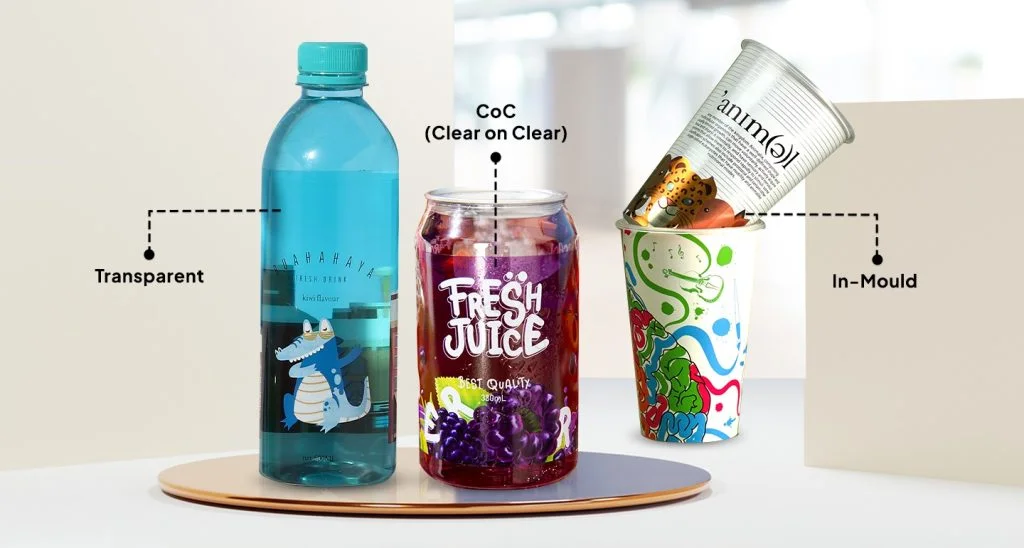
1. PP Transparent: The Foundation of the “Invisible” Effect
One of the most widely used materials for achieving a No-Label Look is PP Transparent (Polypropylene Transparent).
This is not just any plastic. It is engineered with high clarity, allowing it to merge visually with transparent bottles or containers. The boundary between label and packaging becomes almost invisible.
The result?
The label appears to vanish.
Beyond aesthetics, PP Transparent also offers:
- Water and oil resistance
- Strong durability (tear-resistant)
- Versatility across industries
This is why many beverage, skincare, and household brands rely on it as a premium standard.
2. Clear on Clear: Where Transparency Meets Precision
If PP Transparent is the foundation, then Clear on Clear is the refinement.
This approach uses transparent material combined with specially formulated inks that remain visible without compromising the “invisible” effect.
Visually, the result is striking:
- The design appears printed directly onto the packaging
- No visible label edges
- A clean, modern, and ultra-minimal look
In many cases, white ink is applied as a base layer to maintain color vibrancy without losing transparency.
The final effect? A product that looks more premium—without the need for heavy or complex design.
To take the effect further, many brands pair Clear on Clear with finishing techniques such as varnish or foil stamping. See our embellishment capabilities to see what’s possible.
3. In-Mould Label: When the Label Becomes the Packaging
Unlike the previous methods, In-Mould Label (IML) goes beyond appearance—it transforms how labels are integrated entirely.
In this process, the label material is placed inside the mold during packaging production.
This means the label isn’t applied afterward—it is formed together with the packaging.
From a material standpoint, this offers major advantages:
- No peeling or lifting
- High resistance to scratches and moisture
- A perfectly smooth, integrated surface
For No-Label Look applications, the result is seamless:
There is no visible boundary between label and packaging—because there truly isn’t one.
Learn more about the full process and applications on our dedicated In-Mould Label page.
Why Brands Are Making the Shift
More brands are moving away from conventional labels—and for good reason.
With the right materials, No-Label Look delivers:
- A cleaner, more modern appearance
- Direct visual focus on the product itself
- Strong differentiation on crowded shelves
- A higher perceived value
In the eyes of consumers, “simpler” often means “more premium.”
Small Details That Make a Big Difference
No-Label Look isn’t about removing the label. It’s about removing distractions.
And that only works when the material fully supports the effect:
- Consistent transparency
- Strong, flawless adhesion
- A surface that doesn’t reveal edges or boundaries
Choose the wrong material, and the illusion breaks instantly—labels can appear cloudy, shadowed, or obviously separate from the packaging.
A More Strategic Way to Package
In modern packaging, materials are no longer just a supporting element—they are part of your branding strategy.
With the right combination of:
- PP Transparent
- Clear on Clear
- In-Mould Label
You’re not just applying a label—you’re creating a visual experience.
Partner with Cahaya Jakarta Printing
At Cahaya Jakarta Printing, we understand that every detail in packaging matters—especially the materials behind it.
We help brands achieve a precise, clean, and truly premium No-Label Look through the right material selection and expert execution.
Let your product stand out—without looking labeled
Because sometimes, what you don’t see makes the strongest impression.
- WhatsApp: https://wa.me/62811949769
- Email: [email protected]


